

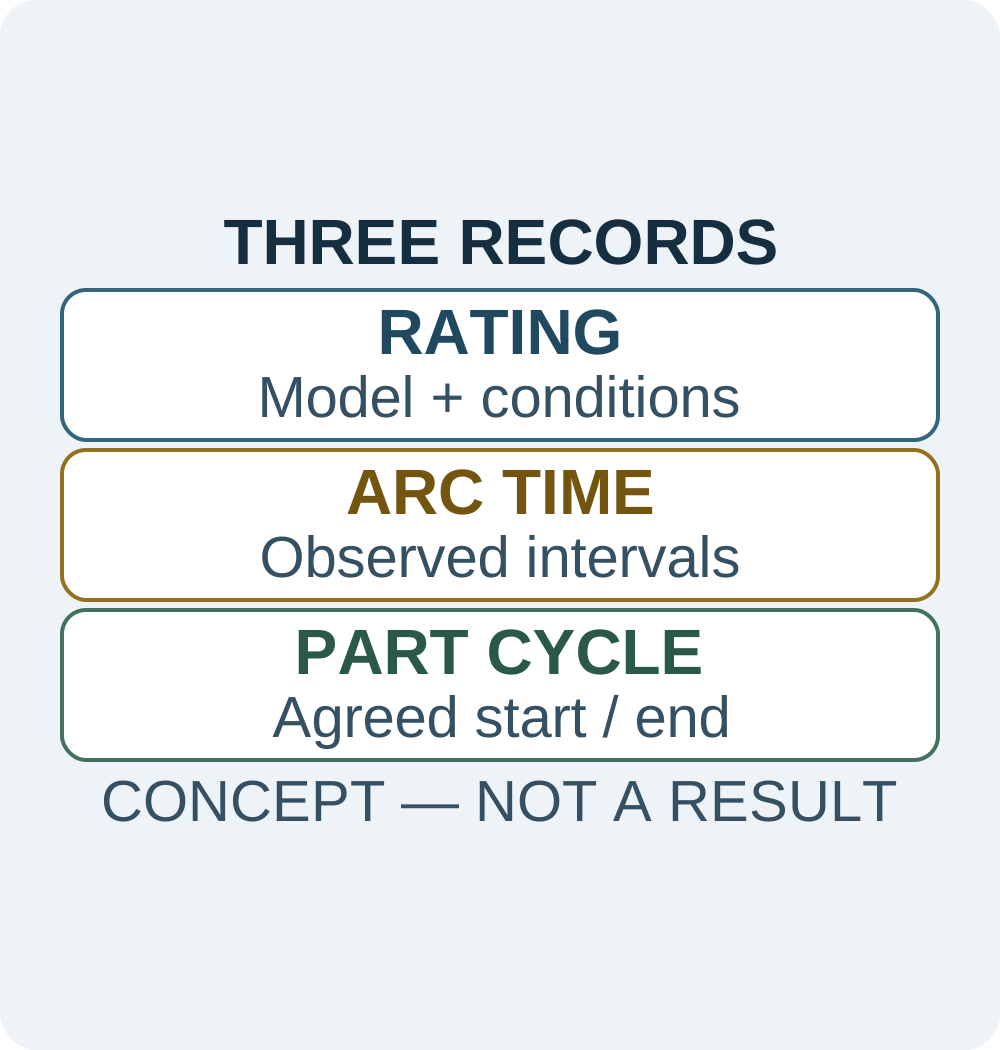
Original concept diagram: equipment rating, arc-on time and accepted-part cycle are separate records. No timeline, equipment specification or customer result is depicted.
In short
No. Duty cycle describes an equipment operating limit under stated conditions; robot cycle time describes a defined production sequence. A percentage on a welding power source is not a parts-per-hour promise. Check the exact equipment documentation and measure the actual trial separately.
Read the rating with its conditions
Miller describes duty cycle as welding time within a 10-minute period at a specified output. Miller Electric, duty-cycle explanation, 8 May 2024; accessed 10 October 2026. Use the chart for the actual model and output, not a percentage detached from its rating conditions. This is manufacturer background, not a CBOXTEC specification or permission to run until protection trips.
Does the power-source rating cover the torch?
Not by itself. Fronius publishes separate robot-torch duty-cycle data with current and stated conditions. Fronius, TPS/i Robotics Push operating instructions, technical data; publication/revision date not stated; accessed 10 October 2026. This does not establish compatibility with CBOXTEC equipment. Have qualified personnel review the actual power source, torch and cooling arrangement together; do not bypass protection or improvise a recovery procedure.
Keep three records separate
For a buyer's trial discussion, use these suggested fields rather than convert a rating directly into output:
- Equipment rating: model, manual revision, output and the manufacturer's stated conditions; unresolved items remain open.
- Arc-on record: actual welding intervals, observed interruptions and the trial setup. Do not infer acceptable cooling from loading pauses alone.
- Accepted-part cycle: agreed start/end points, loading, robot motion, welding, required waiting and inspection; retain stops and rejected parts.
A short successful sample does not establish sustained production capacity. Compare the observed sequence with the equipment instructions and agreed trial scope. See the separate cycle-time evidence guide; an equipment rating and an acceptance result answer different questions.
Questions before extending a trial result
Does 100% duty cycle guarantee continuous accepted production?
No. It is an equipment rating at its stated conditions, not proof of whole-cell capacity or weld acceptance.
Can loading time be treated as sufficient cooling?
Not automatically. The applicable equipment instructions and actual operating conditions need review; this article gives no universal cooling interval.
Is a thermal interruption proof of a faulty robot?
No. Record what happened and have qualified personnel assess the actual system. Do not diagnose the cause from a demonstration video or repeatedly restart the equipment.
Discuss a welding trial with the actual equipment references and intended sequence. Ratings, inclusion, compatibility and achievable production remain project-specific confirmations, not promises made here.