

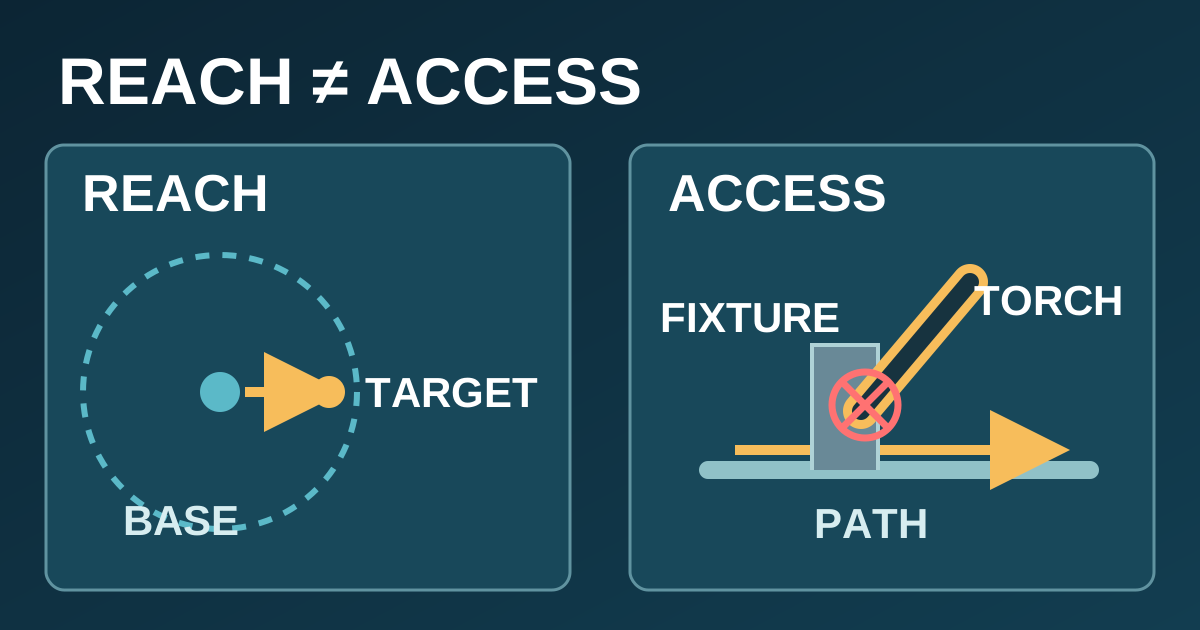
Conceptual access sketch, not a dimensioned cell layout, an approved weld path or a CBOXTEC installation. The shaded obstruction represents a hypothetical fixture.
Does a reachable seam mean the torch can weld it?
No. A reach figure says something about the arm's workspace, but a weld also needs a usable torch angle, clearance around the torch and a feasible motion along the whole seam. A point within nominal reach can still be inaccessible in the required tool pose. Treat reach as an initial filter, then review the actual torch, part, fixture and robot base together.
Picture a corner behind a clamp
Imagine a seam on the inside corner of a bracket held beside a tall clamp. The torch tip may reach the seam's midpoint. Yet the nozzle could meet the clamp when tilted toward the joint, or the arm could approach the first end but lack room to continue to the other. Moving the base, changing the fixture or revising the planned approach might change the result. This is an illustrative question for engineering review, not a recommendation for any particular layout.
| Check | What to show the integrator |
|---|---|
| Endpoints and full path | Mark the seam start, finish and travel direction on the current part drawing. |
| Tool pose | State the intended torch orientation and identify the actual torch assembly. |
| Surroundings | Show clamps, fixture members, adjacent parts and access changes during loading or positioning. |
| Base and motion | Show candidate base locations and ask for a collision and motion review across the path. |
The research paper Comparison of Robot Morphologies and Base Positioning for Welding Applications evaluates welding trajectories with tool-orientation, base-placement and collision constraints. Those are useful categories for an access review; the paper does not validate this hypothetical fixture or any CBOXTEC model. Source: Gautier et al., submitted 8 July 2024; accessed 23 September 2026.
Request evidence for the proposed cell
Ask the integrator to identify which specified seams are reachable with the proposed tool pose and fixture state, and which still need a change or a trial. A drawing and a path review can expose conflicts early; the final cell design, welding procedure and safety measures need their own project-specific validation. A nominal reach value alone is not that validation.
FAQ
Can the torch tip reach while the torch body cannot?
Yes. The tip position does not describe the space occupied by the nozzle, mount, cables and arm at the required orientation.
Is checking the seam midpoint enough?
No. Review entry, travel and exit at the intended orientation, including nearby fixtures and any changed part position.
Does a larger-reach robot solve the access problem?
Not necessarily. Access depends on the whole tool pose and path, fixture, base position and surrounding geometry. Ask for a review of the specific proposal.
Discuss a weld path and fixture. Share drawings or photographs and the intended torch assembly; suitability remains subject to integration review.