

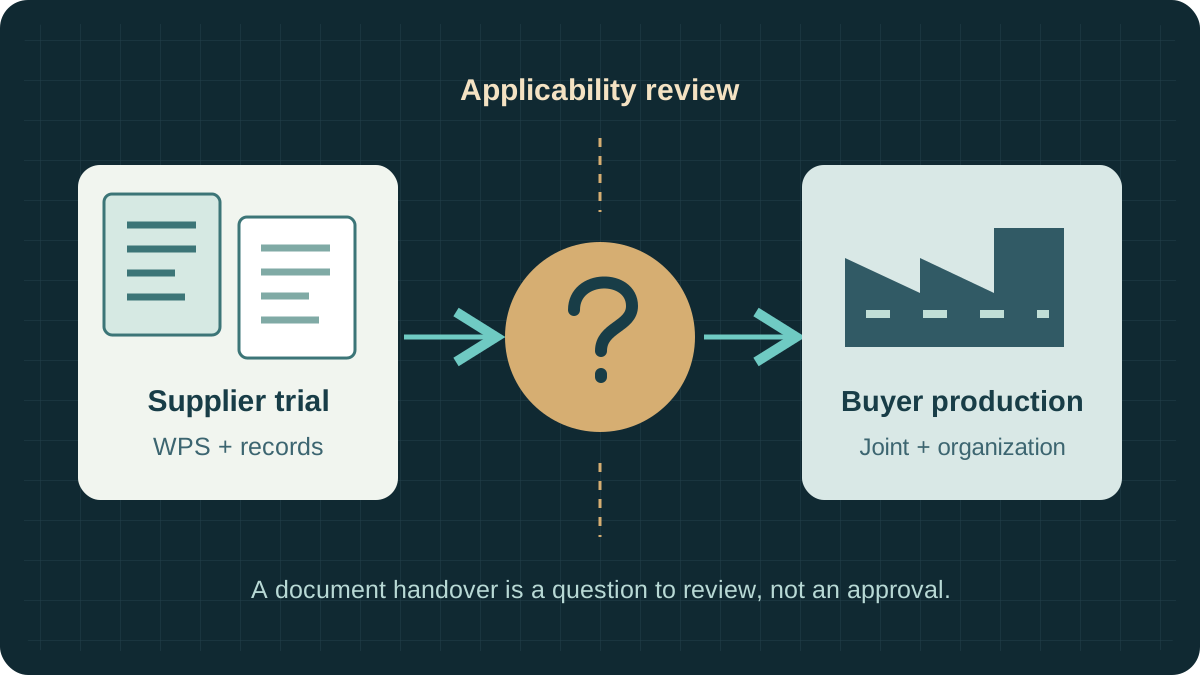
Original concept diagram: supplier trial documents pass through an applicability review before being considered for buyer production. The English labels identify those three stages; the arrows do not represent approval or a customer result.
A trial WPS is a starting point for review
Do not assume the supplier's welding procedure specification (WPS) can be used unchanged in your factory because its robot produced an acceptable sample. Ask the person responsible for production welding to confirm the applicable code, edition, qualification route and scope. This CBOXTEC guide helps buyers frame that discussion; it does not approve a procedure.
What do the documents actually establish?
A WPS describes the welding variables to use. TWI distinguishes it from the supporting record of how the test weld was made and the examination and mechanical-test results. Receiving a WPS file alone does not show all that evidence. TWI, Welding procedure, Job Knowledge 39; publication/revision date not stated; accessed 2026-10-17.
The trial inspection report answers what was examined on the identified sample. Keep that result separate from whether the procedure is applicable to production; see the guide to weld appearance and inspection evidence.
Can another company use the qualification?
That needs a project-specific decision. TWI's cross-company FAQ says the answer depends on contractual arrangements and the specified application and welding codes. Its code examples are not a substitute for checking the applicable edition. Ask for the basis of the proposed use rather than treating the supplier's document number as permission. TWI, Can one company use welding procedures qualified by another company?; publication/revision date not stated; accessed 2026-10-17.
Which production conditions need to be compared?
Have the responsible reviewer identify the relevant conditions and qualified ranges. ISO's public abstract for ISO 15614-1:2017 describes procedure tests and ranges of qualification within that document's steel and nickel welding scope. It does not establish that your project uses this standard. ISO, ISO 15614-1:2017, public abstract; accessed 2026-10-17.
Use these questions in the purchasing discussion, not as a qualification checklist:
- Which production organization will use the WPS, and what supports its use there?
- Which WPS revision and supporting records apply to the proposed production joint?
- How do the actual material, thickness, joint, process and welding position compare with the applicable scope? Ask the reviewer which other variables matter.
- Who resolves any gap, and what document records the decision before production use?
Questions before accepting the document package
Does buying the same robot make the WPS transferable?
The robot purchase alone does not establish procedure applicability. The production organization, applicable requirements and actual welding conditions still need review.
Does every difference require a new procedure test?
Do not decide that from this article. The applicable qualification route and ranges determine what is covered; a responsible reviewer must decide what a change requires.
Does CBOXTEC supply a qualified WPS with every robot?
This article makes no such offer. Confirm any procedure development, testing, review and document deliverables separately in the written quotation.
Discuss the welding project with CBOXTEC using the production drawing, material identification, proposed WPS reference and the name of the party responsible for the applicability review. Keep unresolved items visible in the quotation.