

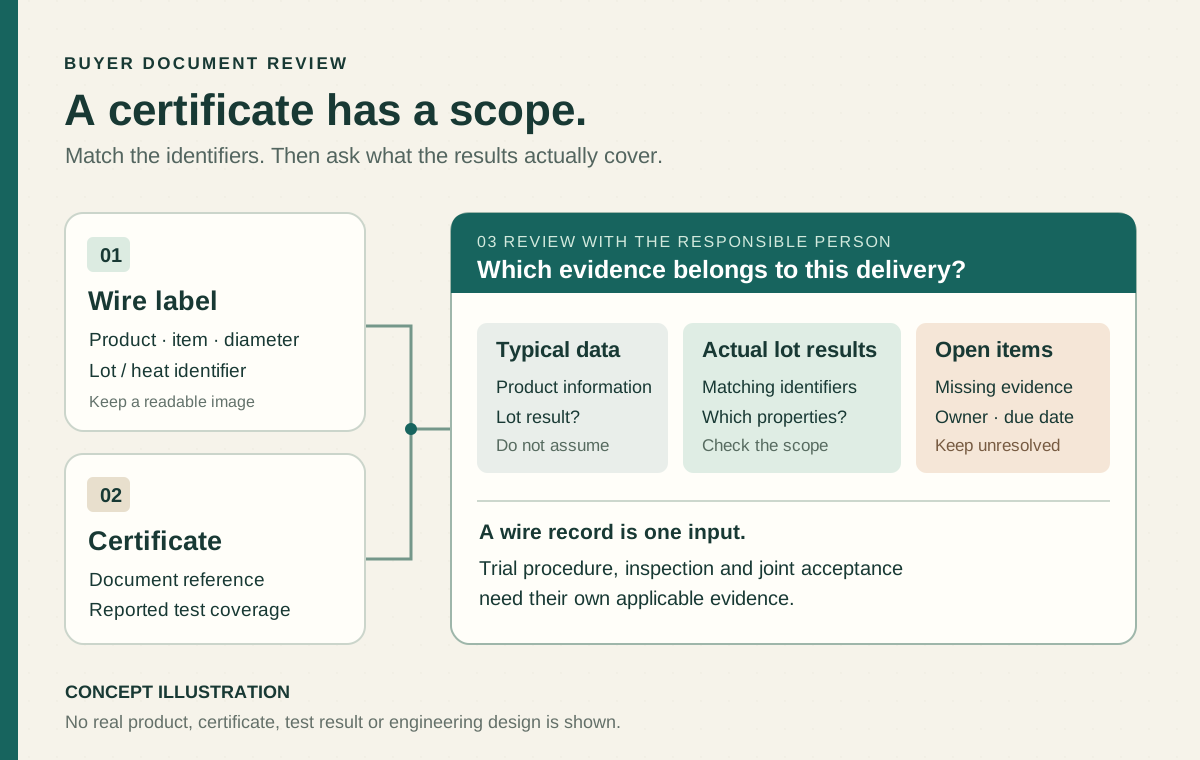
Original purchasing illustration: a wire label and a certificate lead to an evidence-scope review. English labels distinguish typical data, lot results and open items. This is not a product image, a real certificate or a test result.
Ask what the wire certificate covers
Before a robot weld trial, ask which product and lot the wire certificate covers, and whether its values are typical or results for the supplied lot. This CBOXTEC guide helps buyers define that enquiry. A certificate alone does not establish that the proposed process will produce an acceptable joint on your part.
Match the document to the supplied wire
Match the certificate to the wire label. Record the manufacturer, trade name, item number, classification, diameter and lot or heat identifier as applicable. Keep a legible label image and the certificate reference together; do not fill a missing identifier from a similar-looking spool.
ESAB's US certificate-search page asks for product and lot or heat information. It warns that without an item/material and lot number, the selected product receives a typical certificate. This illustrates why searching by product name alone may not provide the evidence for a specific delivery. It is ESAB's retrieval rule, not a claim about every supplier's system. ESAB, Filler Metals Certification Search; publication/revision date not stated; accessed 2026-10-19.
Agree which results are actually required
Ask which reported properties were tested for the relevant lot, and which are typical, declarations or outside the document's scope. A document heading is not a substitute for reading its entries.
Lincoln Electric's catalog distinguishes testing schedules: its Schedule H description concerns chemical analysis for each shipped lot; Schedule J concerns all tests prescribed for the classification. These are examples of different evidence scopes, not a recommendation to order either schedule for every job. Lincoln Electric, Welding Consumables Catalog C1.10, printed page 12, EN Certifications; revision date not established from the opened section; accessed 2026-10-19.
Have the responsible welding reviewer determine the applicable specification, edition, document and test requirements for the project. Do not treat this catalog summary as the current standard text or assume that a chemistry result also supplies mechanical-test evidence.
Put four entries in the purchasing record
These are suggested buying questions, not a standard's mandatory checklist.
- Product and delivery: which exact consumable and delivered lot does the document identify? Record any mismatch or missing label information.
- Evidence scope: which results are actual for that lot, which are typical, and which required properties have no evidence yet? Keep those categories explicit.
- Responsibility and timing: who obtains and reviews the documents, and when must they be available? Agree any additional testing and its cost before ordering.
- Trial link: which wire lot was used on the identified sample, and where are the procedure reference, inspection result and reviewer decision recorded?
Keep certificate review separate from joint acceptance
Distinguish what the wire certificate records from what the trial acceptance establishes. Matching identifiers supports traceability; it does not prove storage condition, feeding behaviour or the finished joint's acceptance. Those questions need their own applicable records and evaluation. For equipment identifiers and delivery-path questions, use the wire-feed quotation guide.
If a wire product or lot changes after the trial, record the change and ask the responsible reviewer what evaluation is needed. Neither automatic rejection nor automatic acceptance follows from this article. Confirm who supplies the consumable and the documents in the quotation; mention of a third-party product does not mean CBOXTEC manufactures, supplies or certifies it.
Questions before agreeing the trial scope
Is a typical certificate useless?
No. It can provide product information, but should not be presented as actual test results for the delivered lot.
Does the same classification guarantee the same trial result?
Do not assume it does. Have the reviewer assess the proposed consumable and actual application; the classification alone does not establish the result.
Must every project buy extra lot testing?
No universal requirement follows here. The applicable requirements and agreed scope determine what documents or tests are needed.
Discuss the welding project with CBOXTEC with the wire identification, available certificate and unresolved evidence questions. Confirm any document or testing deliverables separately in writing.