

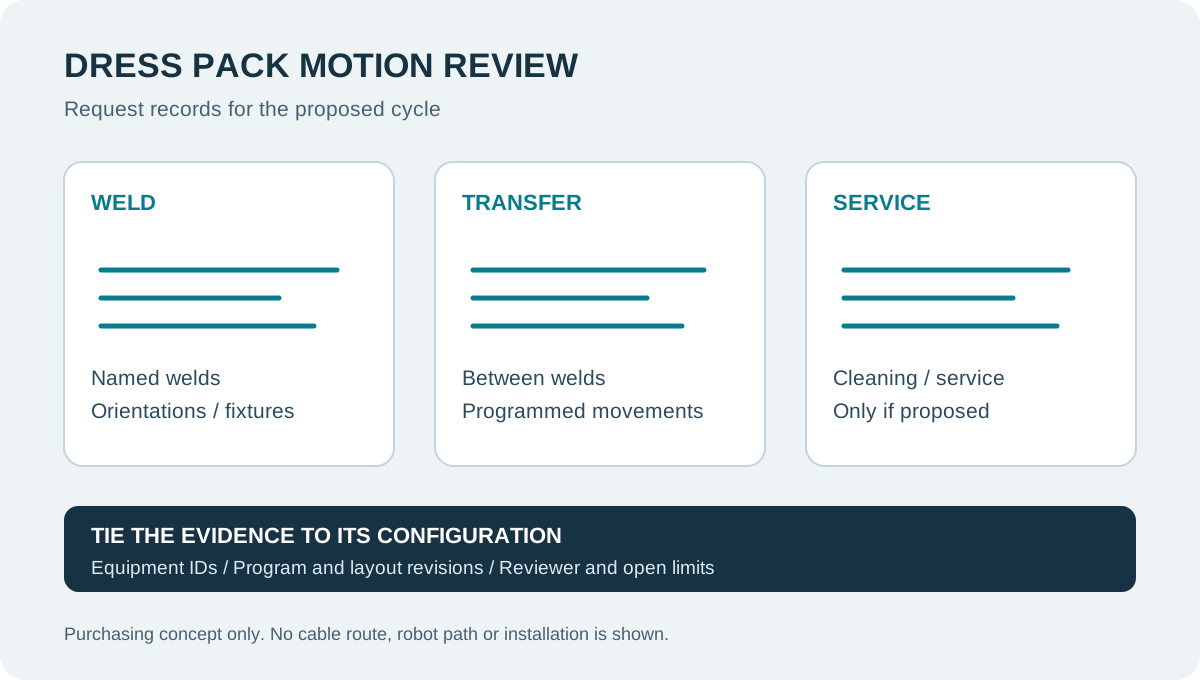
Original purchasing diagram: English labels group motion-review records. It is not a cable route, robot path, product drawing or installation instruction.
Ask for evidence across the proposed cycle
Ask which motions the proposed torch cable and hose arrangement has been reviewed against, and request the matching equipment and program revisions. A photograph at one welding pose leaves that question open. This CBOXTEC guide helps buyers define the evidence to request before comparing offers.
Identify the routing arrangement first
ABICOR BINZEL distinguishes cable routing outside the arm from routing through it. Prof. Emil Schubert, Optimising the service life of welding robots, 2022-08-02, section 3; accessed 2026-10-23.
igus describes retraction systems intended to manage cable-carrier loops. igus, triflex R cable retraction systems for multi-axis robots, introductory section; accessed 2026-10-23. These manufacturer examples explain why the routing and any retraction equipment belong in the discussion. They do not establish brand compatibility, inclusion in a CBOXTEC offer or suitability for a particular cycle.
Specify what the review should cover
Use this suggested record list to agree the review scope with the responsible supplier. It is a purchasing checklist, not an instruction to move or adjust a robot.
| Motion review item | Evidence for this review |
|---|---|
| Equipment identity | Robot, torch and cable/hose part numbers; routing supports and any retraction unit. |
| Welding motions | Named welds and orientations, with the relevant fixture and part revision. |
| Other programmed motions | Transfers between welds and any programmed cleaning or service positions included in the proposal. |
| Review result | Program/layout revisions, checks performed, responsible reviewer and unresolved limits. |
Ask where the applicable cable and hose documents define bending, torsion and mounting conditions. Record missing information rather than borrowing a limit from another product. Agree who confirms the assembled arrangement against those conditions.
Keep motion evidence tied to its configuration
Identify which equipment, fixture, routing or program changes require another review. A simulation, a photograph and an observed trial answer different questions; ask the supplier to state the method used and what remains unverified. None alone establishes cable life, collision-free operation or complete-system safety.
Tool loading has a separate payload review, and joint access has a separate reach review. Include those records where relevant without treating them as dress-pack approval.
Questions to settle before ordering
Does a through-arm design remove the need for review?
No. Ask for the exact cable assembly, applicable conditions and evidence for the proposed motions.
Is a retraction unit always required or included?
Do not assume either. Ask the responsible supplier to identify the proposed arrangement and its written supply scope.
Can a photograph prove the whole cycle was checked?
No. Request the named motions, configuration revisions, review method and remaining open points. Qualified engineering review and agreed verification are still required for the actual project.
Discuss the welding proposal with CBOXTEC using the available layout, equipment identifiers and program scope. Leave unconfirmed compatibility and supply items open for written confirmation.