

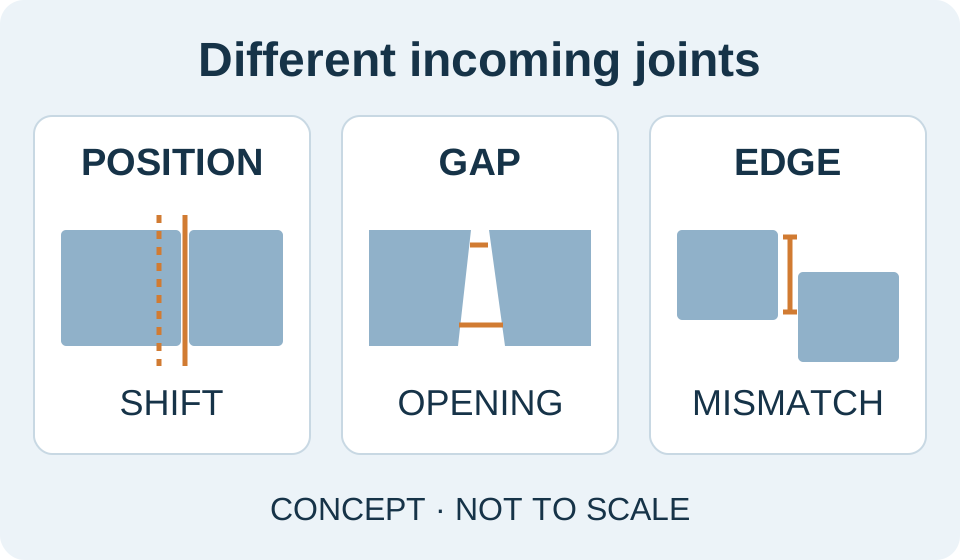
Original concept diagram: a shifted joint, a changing gap and mismatched edges are shown separately. It contains no dimensions, acceptable limits, product configuration or customer results.
A passed sample covers its tested fit-up
One successful robot weld does not establish what happens when production joints arrive with different gaps. Before extending the result, compare the tested joint with normal incoming parts: where the joint sits, whether the gap stays consistent along the seam and whether the edges align. This CBOXTEC guide helps buyers define the next trial; it sets no welding procedure or acceptance limits.
A gap and a shifted joint ask different questions
Fit-up is how the components meet before welding. A joint can move while its shape stays similar, or stay in the same location while its gap or edge alignment changes. Describe position, gap and edge mismatch separately when discussing a trial.
Miller's guidance stresses repeatable parts and gaps, and notes that excessive part variation can require adjustment or rework. That supports checking incoming geometry rather than treating one selected sample as proof for every part. Miller Electric, Welding Robots Can Offer Benefits for Smaller Shops; posted 2024-06-27; accessed 2026-10-13.
There is no universal acceptable gap
An acceptable gap must be established for the actual joint and welding procedure. In its discussion of weld preparation, TWI explains that root gap and bevel angle depend on the process and material thickness, and that an excessively wide root gap can impair weld-pool control. This is guidance about joint design, not a tolerance for your robot or every joint type. TWI, Design — Part 3, Job Knowledge 92; publication/revision date not stated; accessed 2026-10-13.
A smaller gap is therefore not automatically the target. Keep the drawing requirement, observed incoming condition and approved procedure distinct. Ask the responsible welding personnel to resolve differences before choosing test conditions.
Define which variation the next trial will cover
Compare representative production parts with the successful sample. The following are trial-planning questions, not a sampling standard:
- Is the gap consistent along the joint, or does it open and close? Identify measurement locations and the method used; leave unmeasured values unknown.
- Do the edges remain aligned after normal loading and clamping? Record the incoming condition and any extra fitting before welding.
- Which conditions were actually welded and inspected? Link each part to the tested setup, interventions, inspection method and agreed result.
If extra fitting was needed, retain that step in the proposed production scope. Conditions outside the trial remain untested. For broader sample planning, see the robot welding sample-trial guide.
Questions buyers ask about varying gaps
Can a sensor make every gap acceptable?
Ask what the proposed option actually does: correct joint position, measure a gap or change welding conditions. Request evidence for each included function on your parts. A sensing proposal does not establish joint acceptance criteria.
Is a gap measured at one point enough?
Only if the agreed evaluation supports that scope. A single reading does not describe an unmeasured length or other parts. Agree the measurement locations with the people evaluating the trial.
Can we send only the best-fitting part?
It may demonstrate that condition, but it leaves the other incoming conditions unresolved. Identify the difference before using the result to plan production.
Discuss joint variation with CBOXTEC using the drawings, production parts and measurements you have available.