

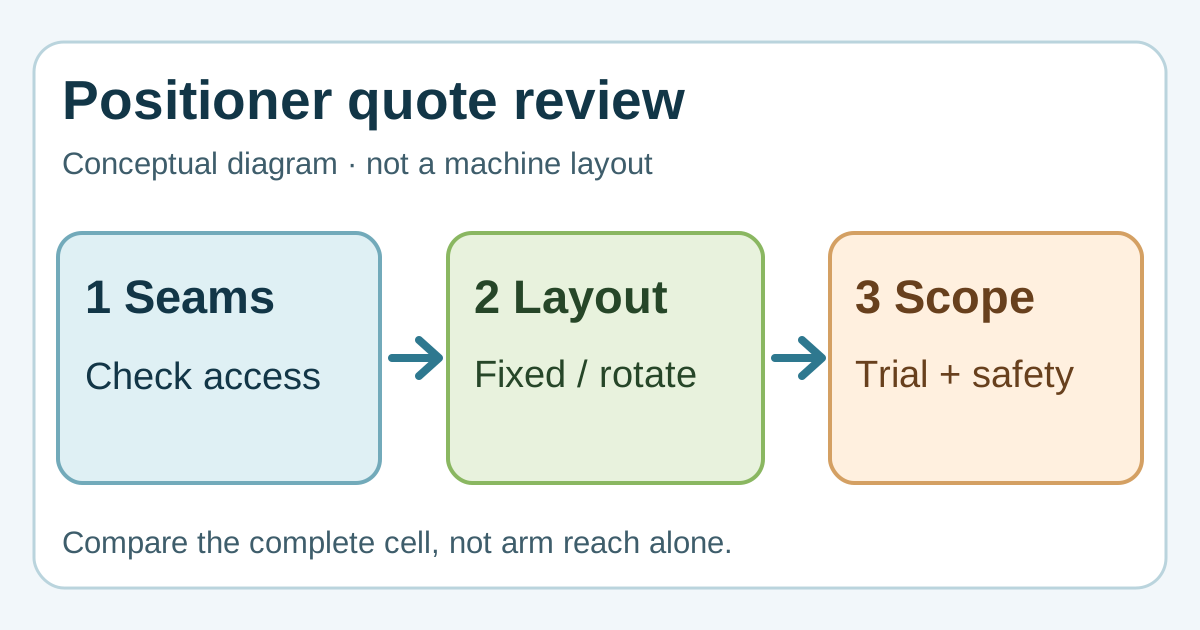
Original planning diagram: compare a fixed fixture with a rotating workpiece before defining the quoted cell. It is not a machine drawing, safety design or CBOXTEC product specification.
Does a welding robot need a positioner?
Not always. A fixed fixture may be sufficient when the actual torch can reach every required seam in an acceptable welding orientation. If several sides require reorientation, evaluate a workpiece positioner with the robot, fixture and process as one proposed system. Do not add a positioner merely because a sample part has multiple welds.
Map the access problem first
Mark each seam on the current part drawing, including the required torch approach, clamps and surrounding structure. Note which seams can be reached without moving the workpiece and which require a different orientation. Show the heaviest representative part together with its fixture and identify the loading and unloading method. A reach figure for the arm alone does not establish usable torch access.
Miller describes servo positioners rotating parts into a desired welding position in one of its own cells. ABB describes a two-axis positioner for workpieces that need rotation to reach a process position, and specifies capacity including the fixture. These are examples of what positioners can do, not evidence that either product fits this project or that CBOXTEC supplies either configuration. Miller Electric, “PerformArc PA1100HW,” accessed 30 September 2026. ABB, “IRP B,” accessed 30 September 2026.
What should a robot part positioner quote show?
A rated payload alone does not describe the loaded assembly or proposed motion. Request the exact positioner model, its applicable manufacturer documents and a reviewed record for the part, tooling and utilities that rotate together.
| Record to request | What the written proposal should identify |
|---|---|
| Loaded assembly | Part, fixture and attached utilities; applicable load, centre-of-gravity and overhang documents; the responsible reviewer. |
| Turning envelope | Loaded geometry and a clearance review through the proposed orientations, rather than one still image. |
| Motion sequence | Reorientation between welds or coordinated motion with the robot during a weld, with the seams and trial evidence covered. |
Yaskawa's MH tooling guidance separately considers load, loaded centre of gravity, overhang and turning envelope. Miller's PerformArc page presents several station and positioning arrangements. These examples frame a quotation discussion; they do not identify a CBOXTEC offering, define a suitable load limit or establish this project's safety or cycle time. Yaskawa Motoman; Miller Electric, accessed 20 October 2026.
Review the loaded layout together with torch access along the full seam.
Compare two quoted layouts
- Fixed fixture: ask how every required seam is accessed, whether manual reorientation is needed, and how repeatable placement will be checked.
- Positioner: ask which axis and motion are proposed, whether robot and positioner move together, and who verifies the combined part-and-fixture load, clearances and guarding.
- Both options: record cycle steps, loading work, floor space, integration responsibility and the seams covered in a representative trial. A faster-looking robot path does not establish the full cell cycle.
Ask the integrator to show the proposed seam and orientation map, state assumptions and exclusions, and trial representative parts before accepting a quotation. Final equipment selection and safety assessment belong to the actual installation; this article is a purchasing discussion guide, not engineering approval.
Discuss a welding-positioner application with the part drawing, seam map and fixture information available.